
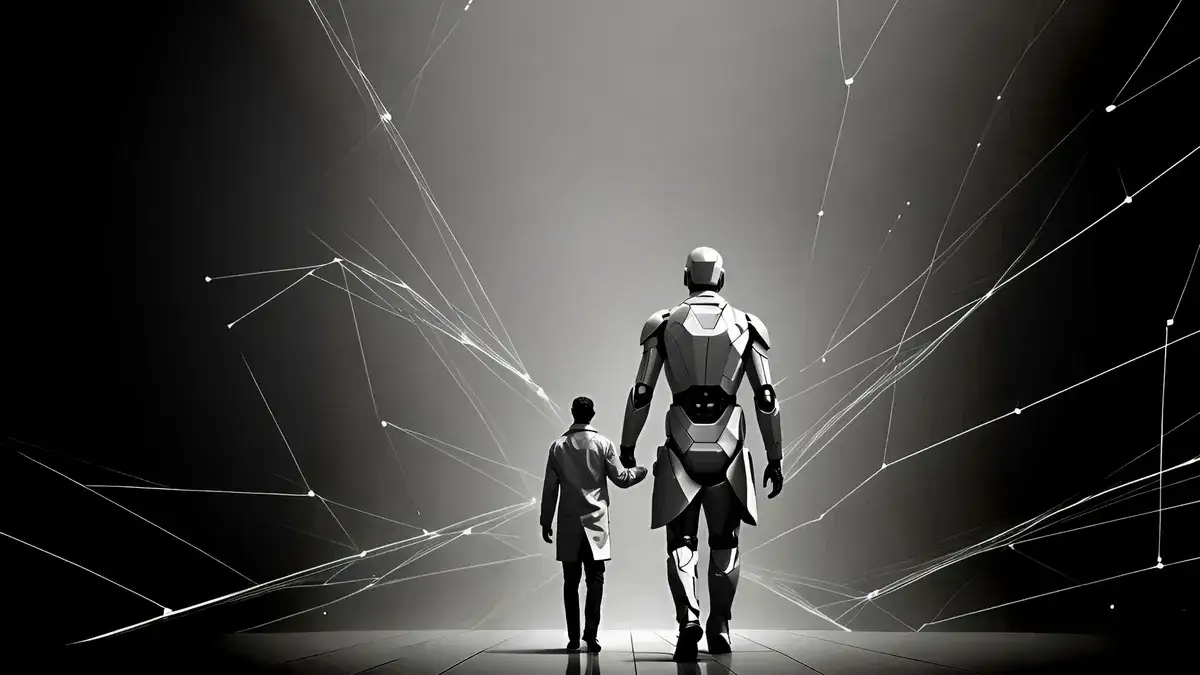
AI is Not a Threat—It's a Massive Opportunity
Over the last two years, most "creative" workers and knowledge workers (intellectual roles) felt their skills were getting usurped or copied (badly at first, but getting scarily better by the day) by generative AI. I say generative specifically, because AI in general has been around for decades, but it couldn't "create" original media.
In just two years, we sprinted from stochastic parrot models to systems exhibiting clear symptoms of reasoning and agency.
The financial and social investment behind this emerging technology is staggering. The rapid progress unfolding right now is equally extreme.
Barring a nuclear holocaust or an asteroid hit, within 5 years we will have autonomous agentic models—AI systems capable of choosing and pursuing goals independently, driven by core reward functions just like humans are driven by survival and dopamine.
Right now (June 2024, for posterity), AI can easily replace anyone acting as a "human peripheral."
Peripherals: hardware devices connected to a central processing unit that execute commands under the control of an operating system.
If your job consists solely of reacting to inputs on a screen, obeying orders from a boss or client, and pushing buttons... bad news. AI can do it. Statistically better on trial one, and infinitely better after a few iterations (where "better" means executing a strict procedure with zero errors). The catch? AI can run 10,000 iterations in the time it takes you to brew your morning coffee.
- You can't beat AI on speed.
- You can't beat AI on precision.
- You absolutely fucking cannot beat AI on speed + precision combined.
Adapt or Extinct
Humans have been playing this game for millions of years.
We aren't the strongest.
We aren't the fastest.
We aren't the biggest.
We aren't invincible.
We are fragile.
Slow (compared to most apex predators).
Inefficient (compared to most prey).
Yet we rule the planet because we adapt. When it gets freezing cold, we don't grow fur—we skin another animal and wear its hide.
When we need shelter, we find a cave. If there's no cave, we build a house.
To eat, we hunt and gather, until we figure out farming and agriculture is a million times smarter.
After millions of years of human evolution, we've built a society with so many layers of abstraction that many of us ended up in jobs that exist purely for the sake of existing.
We got bored, so the best minds on Earth got to work once again.
We built steam engines, combustion engines, electric grids, microchips, and now... intelligent software.
You might look at current AI tools and call them "dumb." Sure, hold onto that opinion. But it's going to hurt a lot worse when a "dumb" model takes your job.
Personally, I hope it's a badass model that replaces me (I'm already prepping for that... but that's a topic for another letter).
Adapt. The Luddites failed against the mechanical loom, didn't they? Do you really want to waste your life whining and advocating for red tape just to protect your inefficiency at a job you hate anyway?
The Time I Accidentally Destroyed a Guy's Career with a PDF
About 20 years ago, I worked as a graphic designer and prepress technician for a local print newspaper I co-founded. I was 20, brimming with energy. Every two weeks, I drove to Roma to hand off files at one of the oldest commercial printing presses in Italy.
Over time, I befriended everyone in the prepress room, including the photocompositor.
If you're under 30, you're probably asking: "What the fuck is a photocompositor?"
Back then, printing a paper required 4 photographic film plates (CMYK) that were manually aligned, exposed, and chemically etched onto aluminum plates.
Those metal plates were the physical master plates used on the press. Well, desktop publishing technology evolved, PDFs were standardized with print registration marks, and I showed the print shop manager how we could bypass the entire photocomposition phase by sending PDFs directly to a Computer-to-Plate (CtP) acid engraver.
Investment made. Job eliminated overnight. The guy wasn't fired out of malice—they offered him a desk role on a Mac, which he stubbornly refused on principle.
Fighting against technological progress is like trying to punch the wind.
Resistance is futile. (Borg – Star Trek)
Adapting is what humans do best. But adaptation clashes directly with our fragile ego and rigid self-identity:
"I am a CREATIVE! I don't do THAT..." "I can't learn new tech..." "That's not for me..."
That mindset is our downfall: trying to stay static in a world accelerating at exponential speeds.
No wonder people are stressed out. What did you expect?
For curious, adaptable people, the rise of LLMs like ChatGPT, Claude, Llama, Gemini, and image generators like Midjourney or Stable Diffusion isn't an existential threat—it's the greatest leverage in human history.
The Secret (Ta-da!)
To thrive over the next 20 years, stop being a cog in a machine and start being a creator.
Stop being a human peripheral transferring data from paper to screen, or software to software.
Become someone who creates real value.
A creator.
No matter how advanced AI gets, humans will always seek human connection and trust real people over algorithms.
We crave humanity. That's why people are obsessed with AI right now—because it feels almost human!
AI is just a tool, like Photoshop. The graphic designers who taught me the trade started with ink and ruling pens. When Photoshop dropped, they didn't stop working—they adopted the software, leveled up their work, and charged double.
We are currently in that magical pre-explosion phase: AI is no longer just for hardcore nerds, everybody knows it exists, yet nobody has fully integrated it into their lives. And it's practically free right now.
In 10 years, AI will be embedded in every pocket, device, and workflow on Earth.
Starting right now gives you the same unfair advantage as launching an e-commerce bookstore in 1996 (yeah, Amazon).
Today, AI is like the early internet in the 90s: open infrastructure.
The internet transformed global commerce, but it didn't eliminate human desire—it just opened up a zero-friction distribution channel.
Those who adapted flourished (online news, podcasts, digital storefronts); those who resisted got left behind in the dust.
AI is not just a tool to "use"—it's an artificial collaborator.
Anyone who learns to orchestrate and collaborate with AI will unlock an unprecedented era of leverage and prosperity.
New jobs will emerge, new problems will be solved, and new opportunities will open up.
To use the early internet, you needed technical skills (HTML, server config).
To use AI, all you need is the ability to articulate your thoughts, write clearly, and stay curious.
With AI, you have a instant conversational gateway to all human knowledge!
AI is a tireless, hyper-fast collaborator with zero ego. If you're a creative, you just won the lottery. Focus 100% on vision and emotion—let AI handle the tedious execution.
"But I prefer crafting things by hand..."
By all means, do it! But make sure your hand-crafted work carries genuine soul, because if an emotionless algorithm can replicate your "masterpiece" with zero feeling, maybe it's time to rethink your definition of art.
If you pour raw emotion and taste into your work, it will shine through whether you used AI, a typewriter, quill and ink, or red ochre on a cave wall.
AI is simply a hyper-efficient way to delegate precision and repetition—the two things an artist should hate doing anyway.
Creating Content is Now Effortless. But You Have to Get Mad.
The barrier to entry in the creator economy right now is literally zero.
- No hardware investment needed—the phone/laptop you're using to read this is more than enough.
- No software investment needed—free tools, stock assets, and AI models exist for everything.
- No ad spend needed—social algorithms provide free organic distribution if your content is good.
All you need to start is an inventory of your skills, interests, and perspective.
If you communicate authentically without corporate filters, you'll attract people who resonate with your voice. Boom: you found your niche.
If you don't know what to post or create, it's because you haven't taken the time to know yourself.
Get mad at yourself!
Your mind is fogged up, drunk on fake social media role models and superficial goals. Your internal compass is off. The sooner you realize it, the sooner you can rewrite your story.
Stop trying to copy internet gurus—you don't actually care about their lifestyle! You're just regurgitating what algorithms fed you to turn you into a compliant consumer.
Here's a 10-minute gut check:
- Take 10 quiet minutes with zero distractions.
- Grab a notebook and pen.
- List 10 topics related to your core curiosity that you could talk about endlessly.
If you can do that, awesome: you just unlocked your content strategy. Start expanding on those topics in posts, videos, or essays.
If your mind goes blank, it's time to re-evaluate your "passions."
Let's Take a Step Back
Say my core interests are: web design, human biology, and philosophy.
Taking a step back, I map those to macro-categories:
- Web design → Tech, digital business, design systems.
- Biology → Health, longevity, physical performance, lifestyle.
- Philosophy → Mindset, personal growth, emotional mastery.
Stepping back further, these map directly to the 3 eternal markets: Wealth, Health, Self-Actualization.
Suddenly, generating content becomes effortless. Millions of people care about these topics; the only unique filter is YOU—your angle, your tone, your hot takes.
AI is your ultimate force multiplier here:
- LLMs: Brainstorming, logical teardowns, parsing complex PDFs, research synthesis.
- Image Models: Custom visuals, concepts, mockups, brand assets.
- Search-enabled AI: Fact-checking, citations, synthesizing deep concepts in real time.
The core idea, the voice, and the vision belong to you. AI has no heart—you supply the soul.
The Polish artist who said: "I want AI to do my laundry and dishes so I can do my art..." needs to realize that if her "art" is easier for a robot to replace than folding laundry, she might want to rethink her craft.
I am not afraid of AI. I'm obsessed with it. I use it every single day, and my personal output has scaled 100X because I get to focus entirely on curiosity and ideas.
AI helps me:
- Conceptualize & research
- Outline & draft
- Fact-check & analyze
- Design next-level iterations
Topics that used to require 10 hours of podcasts and two 400-page books can now be digested in days.
AI eliminates the grinding boredom of production, leaving you free to explore, experiment, and create. It's no longer just "work"—it's craft.
AI Isn't the End—It's Just the Beginning
The Bottom Line:
- AI isn't a threat; it's a paradigm shift → Adapt.
- Your job title is temporary → Evolve.
- The new digital economy rewards value creators → Build.
Here is your battle plan:
- Identify what truly fascinates you.
- Anchor it to an eternal market (Wealth, Health, Relationships).
- Use AI to research and outline your ideas (eliminate blank-page syndrome forever).
- Craft content in your authentic voice.
- Engage directly with your audience.
- Solve real problems with products or services.
- Test, gather feedback, iterate, and repeat.
That's all for this one. Now go build something.
— Manuel